
Office Pods for Focus and Wellbeing: Creating Healthier Open-Plan Workspaces
Open-plan offices can support communication and teamwork, but they also expose employees to conversations, phone calls, machinery and constant movement. When people need to concentrate, a lack of quiet space can become a daily source of frustration. Office pods and acoustic pods offer a practical way to create private, calmer zones without removing the collaborative advantages of an open workplace.
The best workplace solution is not to separate everyone permanently. It is to give employees a choice of settings: open areas for collaboration, enclosed pods for focus and private rooms for longer meetings. This article explains how acoustic office pods support concentration, privacy and workplace wellbeing, and how to select the right HECOR configuration.
Why Noise Matters in an Open-Plan Office
Speech is one of the most difficult workplace distractions because the brain naturally tries to understand words. A nearby conversation can interrupt a complex task even when the volume is not especially high. Repeated interruptions create extra mental effort as employees try to return to the original task.
Open-plan offices also combine many different sounds: phone calls, online meetings, printers, keyboards and movement through shared areas. Some employees may need quiet for writing, analysis or design work, while others need to communicate frequently. Without dedicated quiet zones, these needs compete with one another.
A well-planned acoustic office pod gives employees a place to move when they need focus. It can also reduce the amount of speech spreading across the wider office. This supports a more balanced environment in which collaboration remains possible, but concentration is not treated as an afterthought.
For background on how workplace noise and focus can affect employee experience, review the BBC workplace article on open offices. External research should inform workplace planning, but each company should also observe its own noise hotspots and user behaviour.
What Makes an Acoustic Office Pod Comfortable?
An acoustic pod should do more than reduce sound. Employees need to feel comfortable inside it, especially when using the space for more than a short phone call. Important factors include sound control, fresh air, lighting, seating, work surface, power and visual privacy.
HECOR states that its office pods provide speech level reduction of more than 29 dB under ISO 23351-1/2021. This is a speech-focused measure relevant to phone booths and enclosed meeting pods. It should be reviewed together with the pod’s internal acoustic treatment, door seals, glazing and ventilation design.
A comfortable pod should also avoid creating a new distraction. HECOR lists a ventilation volume of 459 m³/h for its office phone booth solution and describes controls for ventilation speed, light strength and light temperature. The correct airflow and control settings depend on the selected model and occupancy, so facility teams should verify the specification before ordering.
During a trial, ask employees to work inside for 20 to 30 minutes. Check whether the fan is distracting, whether the lighting is comfortable on camera, whether the work surface is large enough and whether the pod feels easy to enter and leave.
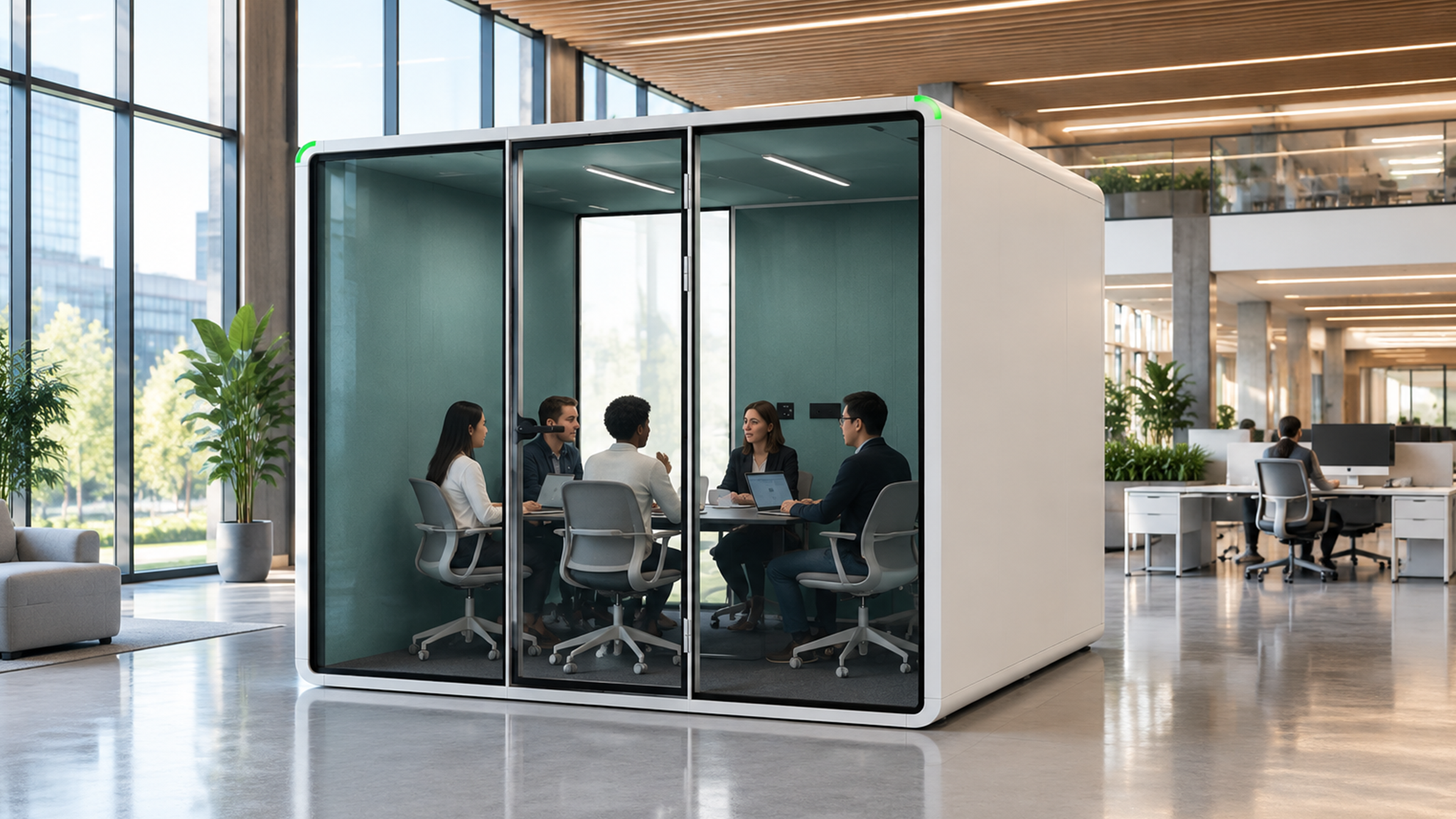
Office Pods Support Different Types of Focus Work
Not all focused work looks the same. Some employees need a private place for a confidential call, while others need an uninterrupted hour to write, review documents or solve a complex problem. Matching the pod to the task improves utilisation.
A single-person phone booth can support short conversations and online meetings. A larger individual work pod may be more appropriate for longer sessions because it can provide additional space for a laptop, notes and a comfortable working posture. A two-person pod can protect the privacy of coaching, interviews and one-to-one conversations.
HECOR’s published range includes Model S, Model M and the ARC Home Pod for individual use. The Model SL is listed for two people, while Model L and Model XL extend the range for small meetings and collaboration.
The right number of pods should be based on real demand. Observe how often employees leave the office to find quiet, how frequently phone calls disturb nearby desks and how long people need the space. This creates a more reliable plan than choosing a quantity based only on headcount.
Acoustic Pods and Workplace Wellbeing
Wellbeing is influenced by whether employees can control their environment. A person who can choose a quiet place for concentrated work has more control than someone who must wear headphones all day or work around every nearby conversation.
Acoustic pods can support wellbeing in three ways. First, they create a physical boundary from visual and verbal interruptions. Second, they provide a transition between collaborative work and individual focus. Third, they give employees a practical option for sensitive conversations that should not be overheard.
This does not mean every employee should work inside a booth continuously. Pods work best as part of a varied workplace that includes open collaboration areas, social spaces, conventional meeting rooms and quiet zones. Clear usage guidance is helpful: keep calls to appropriate lengths, leave the pod ready for the next person and avoid treating a one-person pod as a permanent office.
Materials and indoor-air considerations are also relevant. HECOR’s official product information references GREENGUARD Gold certification, CE certification and UL 962 compliance. Procurement teams should request current documentation and confirm that it applies to the exact model being specified.
How to Create a Quiet-Zone Strategy
A successful acoustic pod installation begins with observation. Walk through the office at different times and identify where calls, equipment and movement create the greatest disruption. Ask employees which activities are hardest to complete in the open area.
Next, map the activities to pod types. Use single-person booths for frequent calls and short focus sessions. Use two-person pods for interviews and private conversations. Use four- or six-person pods for hybrid meetings and small-group work. HECOR’s products page provides a starting point for comparing published capacities.
Finally, plan the location. A pod should be easy to find but not placed directly beside a printer, kitchen or busy entrance. Leave room for the door, cleaning and ventilation. Check lift dimensions, corridors, ceiling height, floor conditions and electrical access before delivery.
The location also affects adoption. If employees have to cross the entire office to reach the nearest phone booth, they may continue taking calls at their desks. If the pod is placed in a natural but calm circulation zone, it is more likely to become part of the daily workflow.
Why a Modular Pod Can Be Better Than Permanent Construction
A permanent room can provide privacy, but it also fixes the layout and may require contractors, permits, electrical work and changes to building services. A modular office pod can add enclosed space with less disruption and may be easier to adapt when the team or lease changes.
HECOR describes an aluminum frame and movable design within its office pod solution. The exact mobility features depend on the selected model, so buyers should confirm how the pod is moved and what conditions are required. Even when relocation is not frequent, future flexibility can be valuable for a growing business.
The comparison should include more than purchase price. Consider installation time, floor disruption, room capacity, future reconfiguration, maintenance and employee use. A pod that employees find comfortable and convenient may deliver more practical value than a cheaper enclosure that remains empty.
For technical context on acoustic enclosures and speech-level reduction, see the BSI building acoustics committee. To discuss a workplace plan, use the HECOR contact page.
Conclusion
Office pods can help open-plan workplaces support both collaboration and concentration. By providing quiet, private settings for calls, focus work and small meetings, acoustic pods give employees more control over how and where they work.
The most effective approach is evidence-based: observe noise hotspots, match capacity to activities, test ventilation and lighting, review acoustic documentation and place pods where employees will actually use them. HECOR’s range provides options from one-person work pods to larger meeting spaces, allowing businesses to build a flexible quiet-zone strategy rather than making one large renovation decision.
A healthier workplace is not completely silent. It is a workplace where people can choose the level of interaction and privacy required for the task in front of them. When quiet zones are convenient, comfortable and clearly integrated into the office, employees are more likely to use them before distraction becomes a problem. That makes acoustic pods a practical part of workplace planning rather than an isolated furniture purchase.